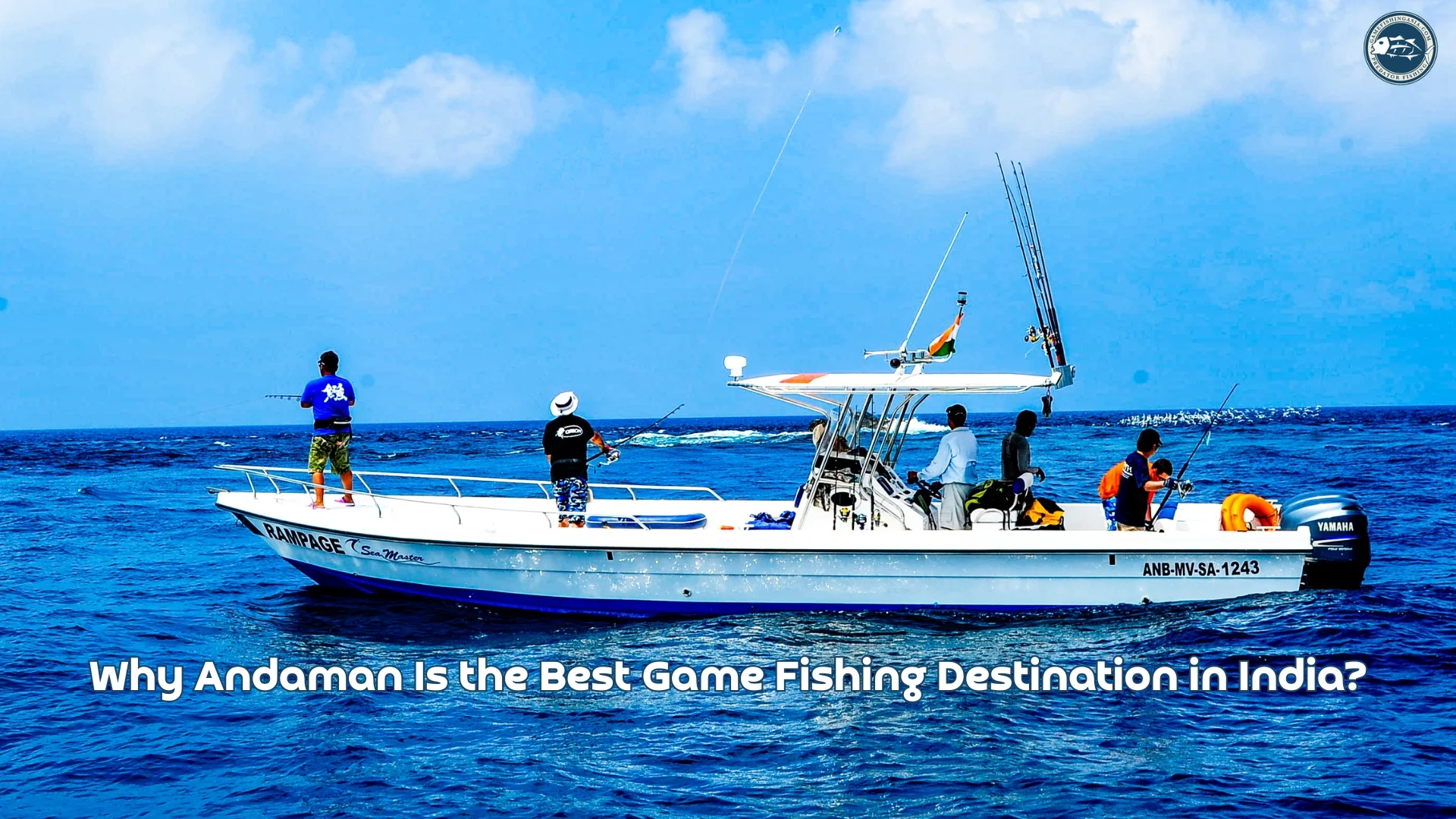
Ever wondered why Andaman Islands are considered India’s top game fishing destination in India? Picture this. A massive fish detonates through the surface just ahead of your lure. Your rod loads instantly, and the fishing reel screams. Your feet scramble for grip on the deck.
That is Giant Trevally fishing in the Andaman Islands. And nothing else in India comes remotely close.
Not the backwaters of Kerala. Not the coastline of Goa, not Lakshadweep. The Andaman Islands occupy a category entirely their own – and after nearly two decades of running professional game fishing charters in these waters, the team at Gamefishing Asia™ can tell you precisely why.
This is a complete guide. It covers the fish, the locations, the seasons, the boats, the techniques, the safety, and every reason why serious anglers from India, the UK, Europe, the Middle East, and Australia keep returning to the Andamans year after year. By the time you finish reading, the decision will be obvious.
The Strategic Location That Makes Andaman Fishing Exceptional
Geography is destiny in sport fishing. The Andaman Islands sit at one of the most productive ocean intersections in all of Asia.
Positioned in the eastern Bay of Bengal – where it meets the deep, open waters of the Andaman Sea – this archipelago lies directly on the migration pathways of major pelagic species. Warm tropical surface currents collide here with cold, nutrient-dense upwellings from the ocean floor. That collision triggers a marine food chain of extraordinary productivity.
Baitfish congregate in massive concentrations. Predators follow the bait. And those predators – Giant Trevally, Dogtooth Tuna, Black and Blue Marlin, Wahoo, Yellowfin Tuna, Sailfish – grow large and aggressive here because the food supply never fails them.
The underwater terrain amplifies this further. The waters surrounding the Andamans contain:
- Deep ocean trenches close to shore – giving large pelagic fish immediate access to reef structure
- Coral reef systems and dramatic drop-offs – holding resident predators year-round
- Offshore seamounts and submerged banks – acting as natural concentration points for bait and hunters alike
- Nutrient-rich upwellings – sustaining constant baitfish activity that drives surface feeding behaviour
The result is a marine ecosystem that is genuinely world-class. Because the majority of the 572 islands in the archipelago are uninhabited – many accessible only to purpose-built offshore vessels – the reefs see almost no recreational or commercial fishing pressure.
Unpressured fish behave differently. ➢ They are aggressive. ➢ They are curious. ➢ They attack lures with total, uninhibited commitment. That is the fundamental advantage the Andamans hold over every other fishing destination in India.
Andaman vs. Other Fishing Locations in India
| Feature | Andaman Islands | Mainland India Locations |
|---|---|---|
| Water Clarity | Excellent – 20m+ visibility | Moderate – 3-8m typical |
| Fish Diversity | Very high – 15+ target species | Limited – 4-6 common species |
| Fishing Pressure | Low – remote, minimal commercial activity | High – heavily fished coastlines |
| Offshore Access | Productive grounds close to shore | Often hours of travel are required |
| Natural Scenery | Tropical jungle, volcanic islands | Industrial coastlines, ports |
| Professional Charters | Available, high-quality operators | Limited options, inconsistent quality |
| GT Fishing Viability | India’s only serious GT destination | Effectively non-existent |
| Trophy Fish Potential | Very high – 30-60+ kg fish are common | Low – large fish are rare |
| Marlin Fishing | Seasonal offshore opportunity | Effectively unavailable |
No other region in India matches this profile. The combination of clear water, low pressure, diverse species, and genuine big-game fish is found only in the Andamans.
Fish Species You Can Target in the Andaman Sea

| Species | Average Size | Primary Technique |
|---|---|---|
| Giant Trevally (GT) | 20-50+ kg | Topwater Popper / Stickbait |
| Black & Blue Marlin | 70 kg+ | Heavy trolling / live bait |
| Dogtooth Tuna | 20-50 kg | Speed jigging / topwater |
| Yellowfin Tuna | 15-60 kg | Trolling / Towater |
| Wahoo | 15-40 kg | High-speed trolling |
| Sailfish | 30-50 kg | Trolling / live bait |
| Mahi-Mahi (Dorado) | 10-25 kg | Trolling/spinning |
| Barracuda | 8-20 kg | Spinning / high-speed troll |
| King Mackerel | 5-20 kg | Trolling/casting |
| Bohar Snapper | 5-15 kg | Jigging / slow-pitch |
| Rusty & Ruby Snapper | 3-10 kg | Vertical jigging/bait |
| Coral Trout | 2-8 kg | Jigging/bait |
| Grouper | 5-25 kg | Jigging / live bait |
| Napoleon Wrasse | 10-30 kg | Deep jigging |
| Rosy Jobfish | 3-8 kg | Light jigging |
This depth of species diversity is found nowhere else in India. Several of these species – Black Marlin, Dogtooth Tuna, Mahi-Mahi, and Wahoo – are simply not accessible from India’s mainland coast. The Andamans offer them all in a single fishery.
Giant Trevally Fishing in Andaman Islands – India’s Greatest Game Fish
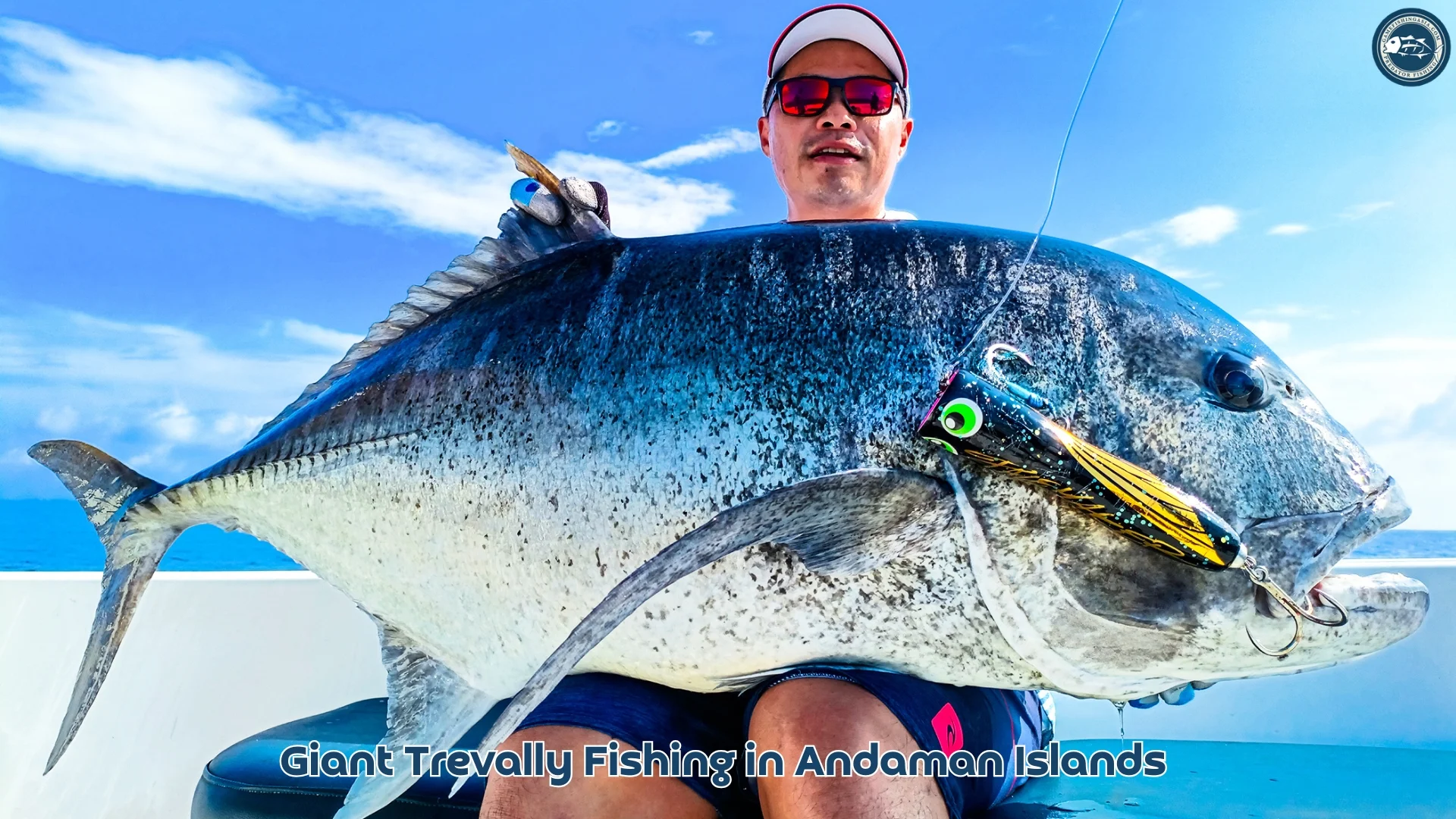
Ask any serious saltwater angler. The Giant Trevally (Caranx ignobilis) is the benchmark species. It defines tropical sport fishing at its most intense level.
GTs are built for violence. They patrol reef edges and current-swept structure with territorial aggression. When a topwater lure enters their zone, the response is immediate and explosive. The first run of a large GT – powerful, fast, relentlessly directed toward structure – is unlike anything else available on a sport fishing rod.
The Andaman Islands are the only location in India where Giant Trevally can be targeted seriously and reliably. Strong tidal currents push through narrow channels and across reef edges exactly where GTs concentrate. Baitfish are abundant year-round. And the minimal fishing pressure means these fish respond to lures with full, uninhibited aggression.
At Gamefishing Asia™, our anglers encounter GTs in the 20 to 50 kg range routinely during the core season. Fish above 40 kg are caught each year. These are current fishing realities – not historical records. We target prime GT zones across North Andaman, the reef systems off Little Andaman, the volcanic structure around Barren Island, and the remote outer grounds of the Invisible Bank – areas where the fish have experienced almost no lure pressure across their entire lives.
When you cast into that environment, the outcome is different. The fish are wilder. The strikes are harder. The memories last longer.
Black and Blue Marlin – Offshore Giants of the Andaman Sea
Marlin fishing in the Andaman Islands is a chapter of this fishery that most visiting anglers do not expect. Yet the seasonal presence of both Black and Blue Marlin in these waters is well documented – and for anglers who have come specifically for GT, finding a Marlin on the troll between grounds is one of the genuine bonus experiences of the Andaman fishery.
Black and Blue Marlin are targeted using spread trolling with large skirted lures, plugs, and rigged natural baits worked at distance and depth. Teasers raise fish from deep water. Live-bait presentations over productive ledges and current lines produce some of the most reliable responses. Around Barren Island and the Invisible Bank, the combination of deep structure, strong offshore current, and abundant baitfish creates the exact conditions that draw these apex predators to within range.
These fish are serious. A Black Marlin at 70 kg or above will test every component of your tackle and every decision you make in the fight. The offshore grounds we access – particularly the deep-water ridges beyond North Andaman, Little Andaman, and the Invisible Bank – hold fish consistently during the seasonal window.
Best season for Marlin in Andaman: February through April, with the strongest activity typically occurring around March.
Techniques: Heavy trolling, rigged natural bait, live-bait presentation over offshore ledges.
Dogtooth Tuna – The Andaman Sea’s Deepwater Powerhouse
Known for blistering initial runs and the kind of brute power that exposes weak tackle immediately, Dogtooth Tuna are one of the most demanding species in the Andaman fishery.
What makes the Andaman Islands genuinely unique for Dogtooth Tuna is a capability that very few destinations worldwide can claim: these fish can be caught here on topwater lures as well as on jigs. The strong tidal flows around deep reef structure concentrate Dogtooth within striking range of the surface during feeding activity. On the right tide, on the right ground, a Dogtooth Tuna in the 30 to 40 kg class will hit a surface lure with a strike that redefines your understanding of what a fish is capable of.
Speed jigging at 60 to 120 metres over deep drop-offs and pinnacles is the primary technique. Heavy metal jigs retrieved fast and erratically trigger reaction bites from fish holding over structure. The fight that follows is close to unstoppable – Dogtooth does not tire quickly and will drive you to every limit of your physical endurance and tackle strength.
Key grounds: Barren Island, Invisible Bank, steep drop-offs around North Andaman, Little Andaman, and the South Sentinel Islands.
Best Fishing Spots/Fishing Destination in the Andaman Islands
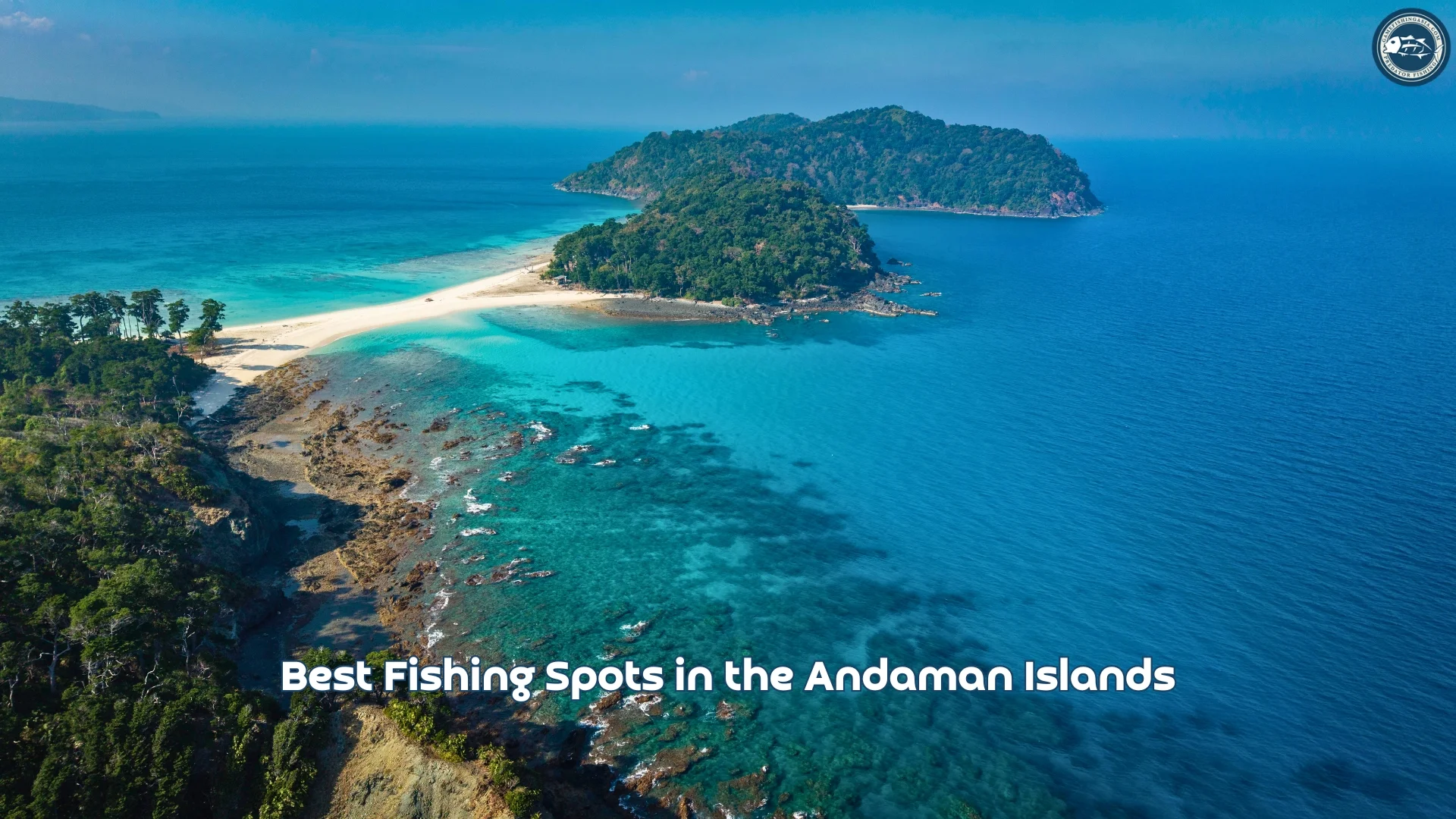
Gamefishing Asia™ operates from three strategic bases across the archipelago – Port Blair, Hut Bay on Little Andaman, and Diglipur in North Andaman. Each base provides access to a different set of prime grounds. Here is what each location and key fishing zone offers.
1. Port Blair (Sri Vijaya Puram): Main Base and Offshore Hub, known as the best fishing spot
Port Blair is our primary operational base and the launchpad for the majority of our charters. From here, productive offshore grounds holding GT, Dogtooth Tuna, Yellowfin Tuna, and seasonal Marlin are all accessible within a practical fishing run. Port Blair is the natural starting point for anglers arriving from Southeast Asia, the Middle East, Europe, and other parts of the Globe. Full-day charters from Port Blair cover a wide range of accessible grounds, while multi-day expeditions depart from here to reach the furthest offshore locations in our programme.
2. North Andaman: Diglipur
The northern extremity of the Andaman chain is one of the most consistently productive big-fish areas in our entire programme. Remote reefs and bait-rich channel systems combine to create conditions that support large populations of GT, Dogtooth Tuna, and Blue Marlin.
GT popping sessions over North Andaman reef structure produce some of the highest-grade surface action we see anywhere in the archipelago. The deep jigging grounds here hold Dogtooth and many reef species in numbers. For anglers willing to travel to reach the most productive waters, North Andaman consistently delivers.
3. Little Andaman: Hut Bay
Wild and surrounded by open ocean, Little Andaman marks the southern frontier of the Andaman chain – just north of the 10° Channel. The reef systems, deep-water channels, and offshore drop-offs here are a fishing paradise.
The result is fish behaviour that experienced anglers describe as unlike anything they have encountered elsewhere. GT strikes on topwater are explosive and entirely unguarded. Dogtooth Tuna on the jig fight with no sense of having been pressured before. Offshore, Little Andaman is a consistent staging ground for Marlin and Yellowfin Tuna on trolled lures and live bait.
This is the destination of choice for hard-core anglers seeking maximum access to genuinely untouched grounds on a multi-day charter.
4. Invisible Bank: The Offshore Frontier
Situated approximately 65 nautical miles southeast of Port Blair, the Invisible Bank is a legendary offshore structure and one of the most sought-after game fishing locations in the entire Andaman Islands programme.
The Bank is a submerged seamount that rises from extreme ocean depths. That dramatic elevation from the seabed creates a permanent concentration point for baitfish, which in turn draws large pelagic predators in extraordinary numbers. GT, Dogtooth Tuna, Yellowfin Tuna, Sailfish, and seasonal Black and Blue Marlin all aggregate here.
Access to the Invisible Bank requires a multi-day charter or a private offshore expedition. The distance and conditions that protect it from casual visitors are also the reason the fishing here is exceptional. GT popping and stickbait casting over the Bank’s reef edges produces heart-stopping surface action. Deep jigging over the vertical drop-offs targets Dogtooth in the 40 to 60 kg class. Big-game trolling on the open-water edges intercepts Marlin and large Yellowfin.
This is Andaman Islands offshore fishing in its rawest, most unforgettable form.
5. Barren Island: India’s Volcanic Fishing Ground
Barren Island is unlike any other fishing location in India. Home to the subcontinent’s only active volcano, it sits in the eastern Andaman Sea surrounded by volcanic lava formations, deep drop-offs, and rich reef systems that exist nowhere else in the country.
The volcanic activity drives powerful current interactions that upwell nutrient-rich deep water – triggering intense baitfish concentrations and the large predators that hunt them. Yellowfin Tuna crash bait balls at the surface. Sailfish appear on trolling runs around the outer edges. Dogtooth Tuna hold over the deep volcanic slopes. GT work the reef structure aggressively, particularly during tidal movement.
Full-day charters to Barren Island combine first-class multi-species fishing with a natural backdrop of extraordinary drama. This is one of the few places in the world where an active volcano forms the backdrop to a topwater GT bite.
6. South Sentinel Islands: Remote Reef Systems
The South Sentinel Islands are among the most isolated fishing grounds we access. Surrounded by deep channels and steep reef walls, this area holds large GT, Dogtooth Tuna, and significant populations of quality reef species. The remoteness of this ground is its defining characteristic – fish pressure here is minimal to non-existent.
Popping and stickbait casting over the reef edges produces explosive GT action. Jigging the adjacent deep structure targets Dogtooth and Amberjack. South Sentinel is typically fished as part of a multi-day programme that combines several remote grounds into a single extended expedition.
7. Havelock and Neil Islands: Accessible Fishing Near Port Blair
For anglers based near Port Blair or fishing on a half-day charter, Havelock and Neil Islands offer accessible, productive grounds holding GT, Barracuda, Mahi-Mahi, and reef species throughout the season. These locations suit families, first-time offshore anglers, and mixed groups who want comfortable access to good fishing without the extended travel of a full offshore expedition.
The Best Time to Visit Andaman for Fishing
October to November – Season Opener
Post-monsoon seas calm quickly. Fish are active and widespread. GT popping is excellent through October. Dogtooth jigging builds fast in November. Multiple species are accessible in the same session – a great time for experienced anglers who want variety and high action without peak-season crowds.
January to mid-February- Peak Season
The finest fishing window of the year. GT concentrations on topwater grounds are at their highest. Dogtooth Tuna hold thick on the jig over deep structure. Wahoo produce exhilarating trolling runs. Marlin activity start to pick up. Yellowfin Tuna start arriving offshore.
Catch rates in January are consistently the highest of the season. These dates fill months in advance. Book early.
Late February to March – Late Season Excellence
Outstanding fishing continues through February and March. GT patterns become more predictable as the season progresses. Winds ease further. Conditions on the water are extremely comfortable. This period suits anglers who want reliable fishing results alongside a relaxed, comfortable experience.
April – Season Close
Good fishing continues into the middle of April. Sea conditions become less predictable as the southwest monsoon begins to build. Final charters of the season depart in this window.
May – Shoulder Period
Moderate sea conditions. Some inner-island fishing is possible. Offshore productivity is inconsistent.
June to September – Monsoon Off-Season
The southwest monsoon closes the offshore season. We do not operate main charters during this period.
Fishing Techniques and Tackle at Gamefishing Asia™
The Andaman Sea supports six distinct big-game fishing techniques – all of them genuinely productive in the same fishery. Here is exactly what each involves, what gear we use, and when each performs at its best.
1. Topwater Popping for Giant Trevally
Topwater popping is as physical and raw as sport fishing gets. Large cup-faced surface poppers are cast to reef edges, rocky outcrops, and current-swept drop-offs, then worked with hard, rhythmic rod strokes that create explosive surface disturbance. The commotion triggers one of the most aggressive predatory responses in the ocean.
Giant Trevally are the primary target. When a GT commits to a surface lure, it attacks at full speed – a strike that is visible, audible, and absolutely violent. The fight that follows is equally demanding. These fish drive instantly and powerfully toward reef structure.
Gear: Heavy-duty popping rods rated PE 8-10, 7’6″ to 8′ in length. High-capacity spinning reels with strong drag systems and fast retrieve rates. 80-130 lb braid mainline with 150-200 lb fluorocarbon leader. Proven popper models include Hammer Head, Amegari, Heru Cubera, Craftbait GT3, Orion Bigfoot, and Cono Cono.
Best season in Andaman: October to November and January to April. Peak GT popping activity coincides with strong tidal movement during the northeast monsoon season.
Target species: Giant Trevally, Dogtooth, Grouper, Bluefin Trevally, Barracuda.
2. Stickbait Casting Over Reefs
Stickbait casting is a more nuanced surface technique. Where popping relies on noise and aggression, stickbaiting relies on presentation and movement. Floating or slow-sinking lures are worked with long, sweeping rod strokes producing a natural side-to-side swimming action – closely mimicking a large injured baitfish moving erratically across the surface.
This approach excels along island shorelines, over submerged reef shelves, and across channel mouths where GTs hold in ambush. The quieter presentation covers ground without alarming fish in shallow, clear water. Strikes are often preceded by a visible wake behind the lure – an experience of anticipation that experienced anglers describe as among the most intense moments in the sport.
Gear: Same spinning setup as popping. Stickbait lures – Fish Trippers, FCL Labo, Carpenter GT Gamma, and Big Lures – in 150 to 250g weight class. These have proven especially effective on pressured or wary fish.
Best season in Andaman: October to November and January to April. Dawn and dusk sessions over known ambush points produce the highest strike rates.
Target species: Giant Trevally, Bluefin Trevally, Dogtooth Tuna (surface), large Bohar Snapper.
3. Speed Jigging for Dogtooth Tuna
Speed jigging is a deep-water technique designed to provoke reaction bites from fast, aggressive predators holding over structure. Heavy metal jigs are dropped vertically to 60-120 metres over underwater pinnacles, drop-offs, and seamounts, then retrieved at maximum speed to trigger instinctive attack responses.
In Andaman waters, Dogtooth Tuna are the headline species. A 30 to 50 kg Dogtooth on a speed jig will expose every weakness in your tackle within seconds of the hook-up. Reef species, Amberjack and large GT also respond aggressively to jigs worked over the right structure.
Gear: Jigging rods rated PE 4-6, 5’4″ to 6′ in length, designed for vertical action and heavy drag pressure. High-torque spinning or overhead reels with strong drag and fast line pickup. 50-80 lb braided mainline with 60-130 lb fluorocarbon or mono leader. Metal jigs in 130-400g range – long knife jigs and centre-weighted flutter jigs in baitfish and UV colours from brands including Shout!, FCL, Zenaq, and Smith.
Best season in Andaman: October to November and January to April. The early-season Dogtooth bite is aggressive and highly productive.
Target species: Dogtooth Tuna, Giant Trevally, Amberjack, Wahoo, large Grouper.
4. Slow-Pitch Jigging for Reef Species
Slow-pitch jigging uses controlled, rhythmic rod movements to work a precisely balanced jig through the water column in a slow, fluttering descent. That falling action – the jig rotating and pulsing as it drops – is what triggers strikes. Many species that ignore a fast-moving presentation will hit a slow-pitch lure without hesitation.
The Andaman reef system is ideally suited to this technique. Grouper, Snapper, Emperor fish, Rusty and Ruby Snapper, Rosy Jobfish, and Amberjack all respond strongly to slow-pitch in 30 to 150+ metres of water over mixed bottom structure.
Gear: Light, parabolic slow-pitch rods rated for 150-350g jigs. Low-gear-ratio reel with smooth drag. PE 2-4 braid. 60-100 lb fluorocarbon leader.
Best season in Andaman: Year-round productive. Peak results during February and March when fish concentrate on known reef structure in the late season.
Target species: Grouper, Bohar Snapper, Rusty Snapper, Coral Trout, Emperor Fish, Rosy Jobfish, Amberjack, Napoleon Wrasse.
5. Offshore Trolling for Marlin, Tuna, and Pelagics
Offshore trolling is the most versatile technique in our programme and the primary method for targeting the full range of open-ocean pelagic species. Multiple lures and rigged natural baits are pulled behind the moving vessel at controlled speeds along current lines, offshore banks, and open-water migration routes. Strikes arrive suddenly – often on multiple rods simultaneously.
For Black and Blue Marlin, we run a spread of large skirted lures, plugs, and rigged baits at various distances and depths. Teasers and dredges help raise fish from deeper water. Live-bait presentations over productive ledges hold fish near the surface. For Yellowfin Tuna and Wahoo, medium to high-speed lure spreads cover vast areas of open water efficiently. Sailfish and Spanish Mackerel complete a multi-species trolling programme that can produce action from the first minutes of the day.
Gear: 50-80 lb class trolling outfits. High-capacity lever-drag reels with strong, reliable performance under sustained load. 80-130 lb mono or braid mainline, crimped leaders, and top-grade swivels.
Best season in Andaman: February through April for Marlin and Sailfish. Yellowfin Tuna trolling produces throughout the core season. Barren Island and the Invisible Bank offshore approaches are the primary trolling grounds.
Target species: Black Marlin, Blue Marlin, Yellowfin Tuna, Wahoo, Sailfish, Mahi-Mahi, King Mackerel, Spanish Mackerel.
6. Live-Bait Fishing for Trophy Predators
Live-bait fishing produces the most natural presentation available in offshore angling. Carefully rigged, lively baitfish are presented near reef structure, current edges, or drifted through open water to attract large, wary predators. The unscripted movement of a live bait – its distress signals, erratic direction changes, natural scent trail – produces a stimulus that no manufactured lure can fully replicate.
In Andaman waters, live baiting opens up opportunities for species and sizes that resist artificial presentations. Marlin, trophy Giant Trevally, deep-water Grouper, and large Dogtooth Tuna all respond strongly. This technique is particularly valuable when conditions make artificial lures less effective – on high-sun, low-tide periods when fish hold deep and cautiously.
Gear: Matched to the target species. For Marlin: 50-80 lb class conventional outfits. For GT and Tuna on live bait: heavy spinning or overhead setups with strong drag. Circle hooks are preferred across all live-bait presentations to support safe catch and release.
Best season in Andaman: October to November and January to April. Most consistent during the middle of the season when baitfish and predator populations are at their simultaneous peak.
Target species: Marlin, Giant Trevally, large Grouper, Dogtooth Tuna, Yellowfin Tuna.
Which Fishing Technique Is Right for You?
| Your Goal | Best Technique |
|---|---|
| Maximum adrenaline, explosive visual strikes | Topwater Popping |
| Subtle surface presentation, reef hunting | Stickbait Casting |
| Deep-water brutes and brutal hook-ups | Speed Jigging |
| Technical fishing, reef species variety | Slow-Pitch Jigging |
| Multi-species action, offshore coverage | Offshore Trolling |
| Trophy fish, natural presentation | Live-Bait Fishing |
On most full-day charters, we combine two or three techniques in a single session – structured around the tidal window, target grounds for that day, and the group’s preferences. Tell us what you’re after. We will build the session around it.
Our Fishing Charter Fleet – Four Vessels Built for Andaman Offshore Fishing
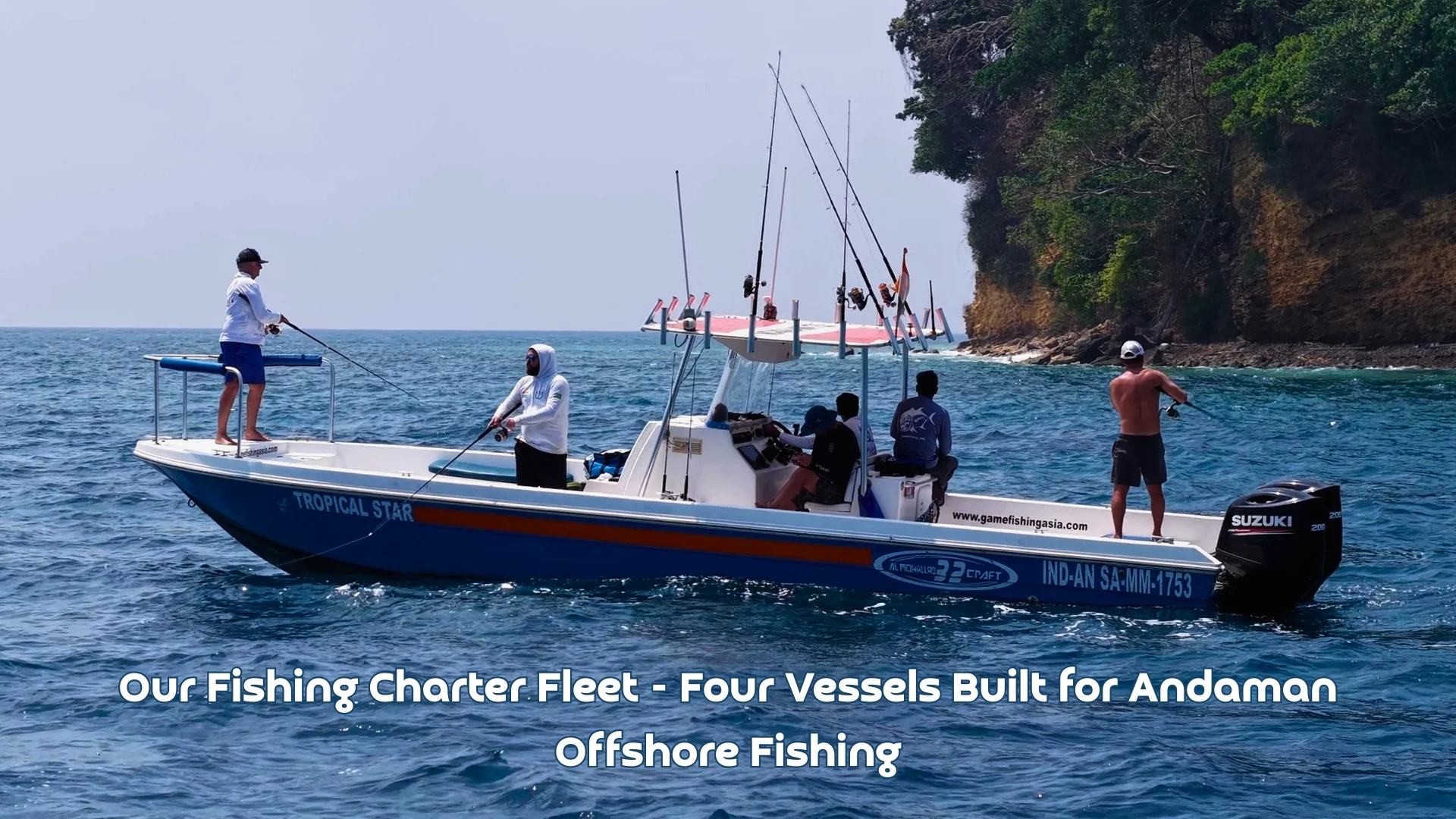
At Gamefishing Asia™, we operate four professional sportfishing vessels – each purpose-built for big-game fishing across the remote Andaman Islands. Every boat in the fleet is capable of fishing 75 nautical miles offshore and beyond, equipped with advanced marine electronics, and crewed by experienced Port Blair fishing captains with deep local knowledge of reefs, seamounts, and seasonal migration routes.
1. 37ft Reef Raider – Professional Andaman Sportfishing Charter Vessel
The Reef Raider is a 37ft centre console built specifically for serious big-game fishing in the Andaman Islands. Its spacious, uncluttered fishing deck gives anglers full freedom to work lures, fight fish, and move throughout a long day offshore. Premium tackle is rigged and ready. Advanced marine electronics – Garmin navigation systems, VHF radio, and AIS tracking – provide complete situational awareness at sea in all conditions.
Reef Raider covers the full range of techniques: GT popping, fast and slow jigging, trolling, and blue-water sport fishing at extended range. Whether you are an experienced tournament angler or fishing offshore for the first time, this vessel delivers a world-class experience.
2. 37ft Rampage – Trailblazing Andaman Big Game Fishing Vessel
The Rampage holds a significant place in Andaman fishing history. It was the first vessel of its class to introduce high-performance, professional big-game fishing to these waters – and it remains one of the most capable and reliable boats operating in the archipelago today.
Built as a 37ft centre console with a roomy, angler-focused deck, Rampage handles every offshore technique with confidence: GT popping, vertical jigging, trolling, and blue-water fishing at 75 nautical miles and beyond. Garmin navigation, VHF radio, and AIS tracking are standard fit. The crew brings expert knowledge of local currents, structure, and seasonal fish behaviour accumulated across many seasons on these specific grounds.
3. 32ft Tropical Star – Agile Professional Andaman Sportfishing Charter Boat
The Tropical Star is the most versatile vessel in our fleet. Slightly more compact at 32ft, it carries the same professional specification, offshore capability, and safety standards that define every Gamefishing Asia™ charter.
Built for speed and agility, Tropical Star reaches productive fishing grounds at 75 nautical miles and beyond with efficiency. The well-designed fishing deck provides comfortable working space for all techniques. Garmin GPS chart plotter, VHF radio, and AIS tracking are fitted as standard. A seasoned Port Blair crew with extensive knowledge of local reef systems, drop-offs, and seasonal fish movement operates this vessel on every departure.
4. 30ft Catamaran Halcyon III – Fast, Stable Andaman Sportfishing Platform
The Halcyon III brings a different capability to the fleet. As a 30ft catamaran, it offers a combination of speed, stability, and open-water comfort that a mono-hull of equivalent size cannot match. The twin-hull design reduces roll in variable sea conditions – a meaningful advantage on longer offshore transits.
Generous deck space, excellent angler mobility, and full Garmin navigation, VHF radio, and AIS tracking fit make Halcyon III a proven platform for every technique we run. Its stability makes it particularly well-suited for guests who are newer to offshore fishing or prefer a steadier ride on extended runs to remote grounds.
Charter Options at Gamefishing Asia
1. Full-Day Charters
Our full-day programme delivers 6 to 8+ hours on the water, with access to offshore grounds, all techniques, multiple species opportunity, and full crew support. This is the right starting point for most visiting anglers.
Standard inclusions: Experienced captain and trained crew, fully equipped charter vessel, rods, reels, bait, lures, and all terminal tackle, GPS navigation and fish-finding electronics, life jackets and full emergency safety equipment, drinking water and refreshments, fishing licences and permits, guided technique coaching throughout, and catch photography.
2. Multi-Day Fishing Expeditions
Our multi-day programme unlocks the furthest and most productive grounds in our operation – Invisible Bank, North Andaman, Little Andaman, the South Sentinel Islands, and Barren Island. Extended time on the water translates directly into deeper access, more diverse conditions, and the real possibility of trophy-class encounters across multiple species on the same trip.
Multi-day expeditions are the right choice for serious anglers who want maximum access to the Andaman fishery and are willing to invest the time that its best grounds demand.
3. Specialty and Private Charters
Our private charter programme is fully customisable. You choose your dates, your target species, your group composition, and your fishing style. Private charters suit individual anglers, couples, families, corporate groups, and serious angling teams who want full control of their programme.
Specialty charters are designed around specific destinations – a dedicated Invisible Bank expedition, a Barren Island voyage combining big-game trolling with topwater GT fishing, or a remote North or Little Andaman multi-day adventure. These trips are built around windows of optimal weather and peak fish activity. Availability is limited – early booking is strongly recommended.
For current pricing, availability, and custom fishing trip planning, contact our team directly.
📞 +91 9900 568091 | +91 7063955070
📍 3 Foreshore Road, Haddo P.O., Port Blair – 744102, Andaman & Nicobar Islands, India
→ Contact Us to Plan Your Andaman Fishing Trip
Sustainability – The Foundation of Everything We Do
At Gamefishing Asia™, sustainability is not a marketing commitment. It is the operational principle that governs every decision we make on the water.
The Andaman Islands produce extraordinary fishing because their marine ecosystem remains genuinely healthy. Protecting that health is how we ensure this fishery continues to perform – for our guests today, and for the anglers who follow them.
Our Conservation Practices
- 100% catch and release for all sport fish – Giant Trevally, Dogtooth Tuna, Marlin, and all major game species are handled carefully, photographed efficiently, and returned in the best possible condition
- Barbless hooks on all lures – reducing injury during the hook-up and release process
- Heavy tackle as a conservation tool – using appropriately rated gear reduces fight time, which directly improves post-release survival rates
- Minimal air exposure – fish are kept in or close to the water throughout photography and release
- Dehooking tools and correct handling technique – all crew are trained in best-practice fish handling to minimise stress and physical damage
- No fishing in protected zones – we operate strictly within areas approved by Indian authorities and the Andaman & Nicobar Islands Administration, avoiding coral reserves, marine sanctuaries, and breeding ground protection zones
- Seasonal guidelines respected – fishing activities are planned around species breeding periods
- Zero waste at sea – all waste returns to shore for proper disposal; plastic use onboard is minimised across all vessels
- Local employment and community support – our crew are local, our supplies are sourced locally, and our presence supports the broader Port Blair fishing community
We are also developing the first Giant Trevally tagging programme in the Indian Subcontinent – the first scientific data collection effort on GT movement patterns, growth rates, and population structure in Indian waters. This research will directly inform long-term fishery management for the Andaman Sea.
➢ Fish smart. ➢ Fish responsibly. ➢ Fish for the future.
Safety on the Water after you reach our fishing destination
Every Gamefishing Asia™ charter begins with a full safety briefing from the crew. Please give it your complete attention.
- Wear your life jacket whenever the crew instructs – no exceptions
- Follow all the captain and crew instructions immediately
- Inform the crew of any medical conditions before departure
- Take motion sickness medication the night before if required
- Stay seated or hold support rails when the boat is underway at speed
- Wear non-slip footwear on deck at all times
- Maintain a safe distance from active hooks, lines, and rod tips
- Stay hydrated and apply high-SPF sunscreen throughout the day
- Do not consume alcohol during the fishing trip
- Supervise children on deck at all times
- Do not lean over the sides of the boat while underway or fishing
- Notify the crew immediately if you feel unwell
Our team holds emergency first-response training and maintains an immaculate safety record across nearly 20 years of operation. Your safety is the non-negotiable first priority of every charter we run.
Who Should Fish the Andaman Islands with Gamefishing Asia™?
1. The GT Specialist – India’s only serious Giant Trevally destination, with access to genuinely unpressured grounds that produce trophy fish every season.
2. The Marlin and Big-Game Angler – Invisible Bank, Barren Island, and the deep offshore ridges of North and Little Andaman provide a genuine multi-species big-game fishery that produces Marlin, Dogtooth Tuna, and large Yellowfin in the same programme.
3. The First-Time Offshore Angler – Our crew coaches and supports every level of experience.
➢ You will catch fish. ➢ You will learn. ➢ You will come back.
4. The International Travelling Angler – Anglers from the UK, Europe, the Middle East, Southeast Asia, and Australia are discovering that the Andamans offer world-class GT and big-game fishing at a level of access and value that established global destinations struggle to match. The fish here are wilder. The grounds are more remote. The experience is more authentic.
5. Families and Mixed Groups – Half-day programmes, light tackle sessions, and mixed-technique charters are all available. Not every guest needs to be targeting trophy GTs.
6. Corporate Groups – A full-day private charter is one of the most genuinely memorable corporate experiences available in India.
Travel and Logistics for International Anglers to Reach Our Fishing Destination
- Getting to Port Blair, fly into Chennai or Kolkata from your international hub. Domestic connections to Port Blair run multiple times daily. Total travel time from London or most European cities typically falls between 18 and 24 hours, including connections.
- Visa India’s e-Visa system covers most nationalities. Applications are processed online before departure. We recommend checking the current Indian immigration portal for up-to-date entry requirements before booking.
- We handle everything else, from airport pickup to daily briefings, tackle preparation, and departure transfers, Gamefishing Asia™ manages every in-destination detail. You focus on fishing.
Why Gamefishing Asia™ is the best fishing charter in the Andaman Islands?
- Operating since 2006 – Nearly two decades on Andaman waters. No other professional charter operator in India has more experience on these specific grounds.
- Three Strategic Bases – Port Blair, Hut Bay (Little Andaman), and Diglipur (North Andaman). We are positioned to fish the entire archipelago, not just the grounds closest to the main town.
- Four Purpose-Built Vessels – Reef Raider, Rampage, Tropical Star, and Halcyon III. All capable of 75nm+ offshore. All equipped with Garmin navigation, VHF radio, and AIS tracking. All are maintained to a professional standard.
- Local Knowledge That Cannot Be Replicated – The reef structure, current patterns, and seasonal behaviour of this fishery are understood by our team at a level that only comes from continuous, dedicated time on the water over many years.
- Results – Our anglers consistently catch more and bigger fish than they do anywhere else in India. Many return each season. That is the most credible endorsement any charter operation can have.
Frequently Asked Questions About the Best Fishing Destination In Andaman Islands, India
1. Is fishing allowed in the Andaman Islands?
Yes. Recreational and sport fishing is permitted throughout most of the Andaman Sea. Certain marine protected zones and wildlife sanctuaries are off-limits. Gamefishing Asia™ holds all required permits and operates in full compliance with Indian fishing regulations on every trip.
2. What is the best time to visit Andaman for fishing?
October to November and January to April is peak season. The full season runs October through April, with excellent fishing available across all months.
3. What species can you catch in the Andaman Sea?
Giant Trevally, Black and Blue Marlin, Dogtooth Tuna, Yellowfin Tuna, Wahoo, Sailfish, Mahi-Mahi, Barracuda, King Mackerel, Bohar Snapper, Rusty Snapper, Coral Trout, Grouper, Napoleon Wrasse, Rosy Job fish, and many additional reef and pelagic species.
4. Do I need to bring my own fishing gear?
No we have a good selection of tackle for rental. All tackle and equipment can be provided and is top notch and well-maintained. If you prefer to fish with your own gear, you are welcome to bring it.
5. Is Andaman suitable for beginners?
Absolutely. We guide all experience levels. You do not need prior offshore experience to have an exceptional time.
6. How much does an Andaman fishing charter cost?
Pricing depends on trip duration, group size, vessel, and programme type. Contact our team for current pricing and availability.
7. How far in advance should I book?
Six months to one year ahead for peak-season dates. Two to three months for shoulder-season windows. Multi-day expedition slots – particularly Invisible Bank and Little Andaman programmes – fill the earliest.
8. Which fish is famous in Andaman?
The Andaman Islands are a world-class marine paradise, celebrated for their rich underwater biodiversity and thrilling sport fishing experiences. These tropical waters are home to prized game fish such as Giant Trevally (GT), King Mackerel (Surmai), Yellowfin Tuna, and Dorado, attracting anglers from across the globe. The crystal-clear coral reefs of the Andaman Sea are equally famous for vibrant marine species, including Clownfish (Nemo), colorful Parrotfish, and majestic Reef Sharks. Adding to the island experience, Andaman’s coastal cuisine features freshly caught snapper, mackerel, and other seafood delicacies, making it a top destination for marine tourism, scuba diving, snorkeling, and deep-sea fishing adventures.
Book Your Andaman Fishing Charter with Gamefishing Asia
The season runs from October through April. Full-day charters, multi-day expeditions, specialty charters, and fully private programmes are all available.
Contact our team. Tell us your dates, your target species, and your group size. We will build the right trip around your goals.
📞 +91 9900 568091 | +91 7063955070
📍 3 Foreshore Road, Haddo P.O., Port Blair – 744102, Andaman & Nicobar Islands, India
→ Contact Us to Book → View Solo Angler Programme
Gamefishing Asia™ has operated professional sport fishing charters in the Andaman Islands since 2006. We specialise in GT popping, stickbait casting, speed jigging, slow-pitch jigging, offshore trolling, and live-bait fishing across the full Andaman archipelago. 100% catch and release. All operations conducted in compliance with Indian sportfishing regulations.